WV Science News
Updates from Senior Scientist Than Hitt for WV Rivers Coalition
Spring 2026
What’s Inside
- Science Feature: Water survey reveals PFAS and oil and gas impacts in WV
- Applied Science: Expansion of designated trout waters in WV
- Science Education: Interview with Brittany Miller-Baker on her students’ national award for clean water technology
- Science Education: Water quality day with Friends of the Cheat
- Monitoring News: We’ve surpassed 10,000 surveys (!) and are adding new monitoring for data center impacts
- Volunteer Spotlight: Will Shrader
- Technical Review: Lower Guyandotte TMDLs
- What We’re Reading: New research on Appalachian waters
Science Feature: Water survey reveals PFAS and oil and gas impacts in WV
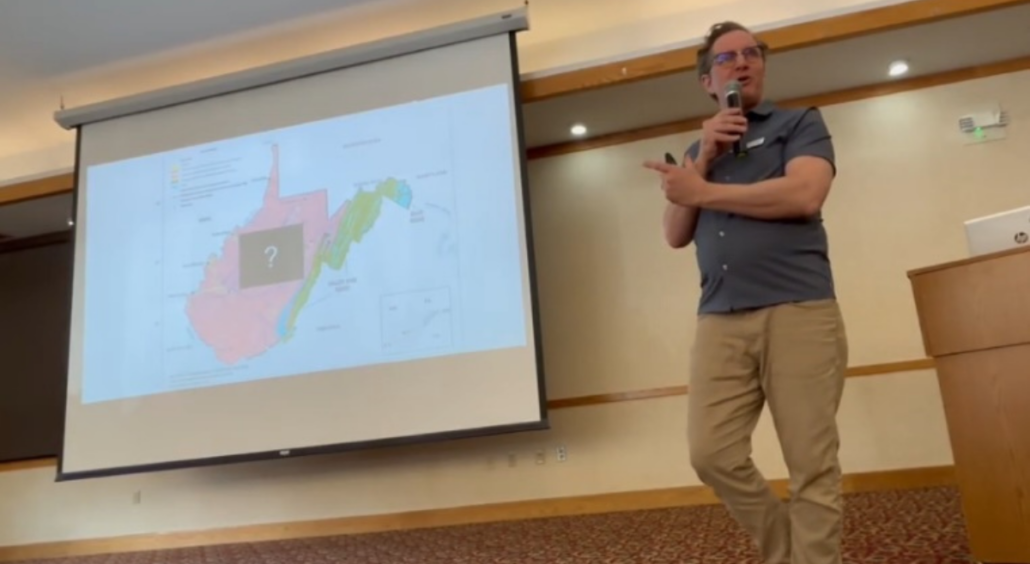
Senior Scientist Than Hitt addressing the Association of Mid-Atlantic Aquatic Biologists annual meeting this spring.
WV Rivers partnered with the Charleston Gazette-Mail to conduct a survey of domestic well water quality across the state, and Than Hitt presented these results at the Association of Mid-Atlantic Aquatic Biologists (AMAAB) annual meeting in Cacapon State Park this spring. The sampling focused on domestic well water samples in the eastern, central and southern regions of the state and included information on bacteria, metals, nutrients, and PFAS “forever chemicals.”
Survey results revealed several important findings for water quality and public health:
- PFAS chemicals were detected in the central region, and that observation is important because prior sampling in that region has focused on surface waters instead of groundwater sources.
- The spatial distribution of PFAS chemicals in the eastern region was very patchy, with nearby samples showing very different concentrations in some cases. This indicates that additional sampling will be necessary to identify regional contamination risks in that region.
- Evidence of oil and gas “brine” was observed in the central region as indicated by high levels of barium and strontium in samples. Repeated sampling confirmed this result. Multiple oil and gas permits are located near the high concentrations of barium and strontium, and additional work is needed to understand the extent of this impact.
This research was supported in part by a Pulitzer Center grant to the Charleston Gazette-Mail. Stay tuned for new results from an ongoing survey of PFAS chemicals in collaboration with the Sierra Club Grassroots Network.
Applied Science: Expansion of designated trout waters in WV
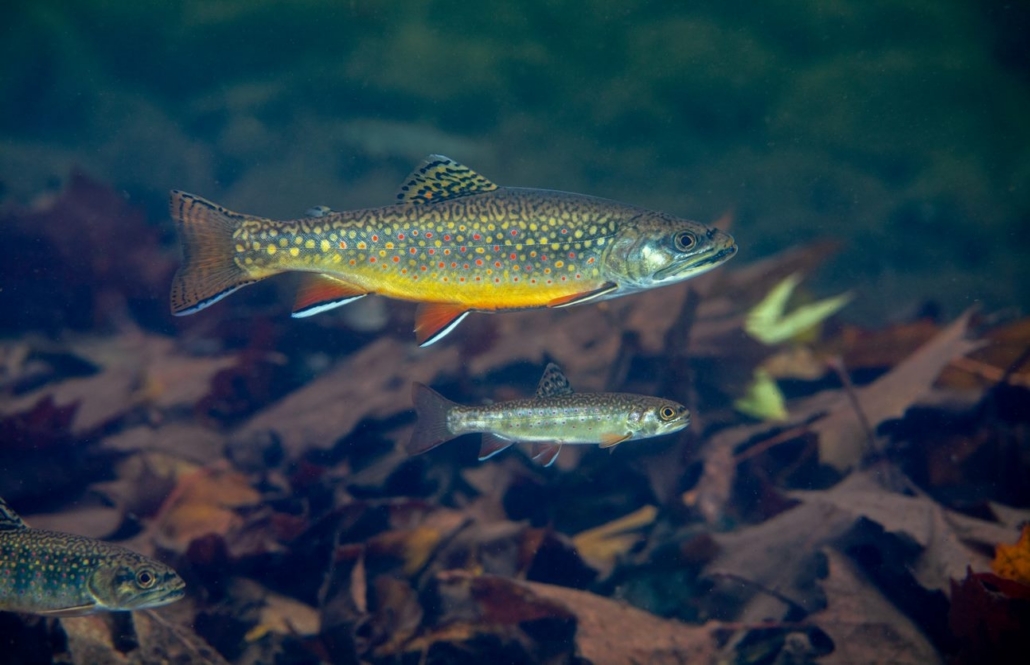
The current set of designated trout waters can be accessed from the DEP’s GIS Viewer under the “Watershed Assessment” tab. (Brook Trout photo by Ryan Hagerty / USFW.)
Here’s some good news: coordination among WV Rivers, Trout Unlimited and state agencies has expanded designated trout waters in WV, adding over 170 miles and including streams in the Cheat, Greenbrier, Elk, Gauley, Potomac River basins. This update reflects new data from electrofishing surveys conducted by Trout Unlimited and the WV Division of Natural Resources (DNR) over recent years. Analysis of the dataset by WV Rivers revealed the presence of juvenile fish in most samples indicating the presence of wild brook trout populations rather than put-and-take fisheries. The new stream designations also strengthen water quality standards for temperature and aluminum.
“West Virginia has incredible wild and native trout resources, and this partnership has helped show just that,” said Dustin Wichterman, the Mid-Atlantic Coldwater Habitat Program Associate with Trout Unlimited. “Our anglers, watersheds and communities will benefit from this public-private partnership effort.”
You can read more about this success story in media coverage here and here.
Science Education: Interview with Brittany Miller-Baker on her students’ national award for clean water technology
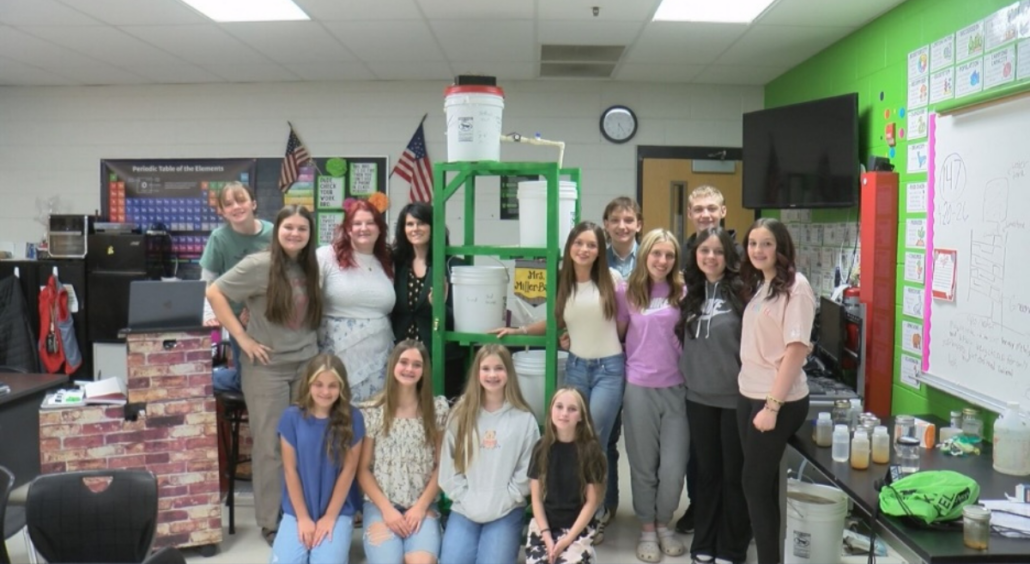
Brittany Miller-Baker (top row, fourth from left) with the award-winning students at Huff Consolidated Elementary and Middle School. Photo credit: www.wvva.com
This April, students from Huff Consolidated Elementary and Middle School in Wyoming County won national recognition at the Samsung Solve for Tomorrow STEM competition for their innovative approach to water filtration. Led by teacher Brittany Miller-Baker, the team placed in the top three nationally and won the Community Choice Award. Here we discuss this accomplishment and what it means for STEM education in WV and beyond.
What does this achievement mean to you? To your students?
To me, it means that the science happening in our little corner of West Virginia is solving problems that matter to real families — our families. Acid mine drainage is a complex legacy of an industry that built this region and powered this nation, and the communities along these waterways deserve solutions that honor both that history and their future. Winning the Samsung Solve for Tomorrow national competition — the first West Virginia school to do so in 16 years — shows that rural Appalachian students are ready to be part of that solution.
To my students, it means they have proof that they can make a difference right here at home. They didn’t just study a water problem — they built something that actually works to address it. That’s a powerful thing for a young person from Wyoming County to carry forward.
What surprised you about the competition? I was surprised by how universally the judges connected with a project rooted in such a specific place. Acid mine drainage in southern West Virginia isn’t a headline issue for most of the country, but when our students explained what it means for the people who live here — families who depend on well water, communities that love these mountains and these streams — people listened. The specificity of our story became its strength. I was also deeply proud of how our students framed the issue — not with anger, but with determination. They understand that coal built Wyoming County, and they also understand that clean water is something every community deserves. They hold both of those truths at once, and that maturity showed.
How will you use the prize money?
Every dollar is going back into student hands. We’re investing in laboratory equipment for real scientific investigation, updated technology for data collection and analysis, robotics and coding tools for engineering design, and makerspace furniture to create a dedicated building and prototyping space. The goal is to keep producing the kind of students who can sit at the table when hard conversations about water, land, and community health are happening — students who bring data, solutions, and a deep love for this place.
What advice would you give to other educators to achieve this kind of success?
Find the problem your community is already living with and build from there. Don’t shy away from complicated topics — complexity is where critical thinking grows. Acid mine drainage sits at the intersection of environmental science, economics, history, and community identity. There’s no villain in that story, just a hard legacy that deserves thoughtful solutions. When students understand that nuance, they become better scientists and better citizens. Trust your students to handle the full truth of where they live — they almost always rise to meet it.
Is there anything else you’d want me to tell the WV Rivers community about this?
I’d want them to know that our students love this place. They love the mountains, the streams, the communities their families have called home for generations. They also understand that the same industry that gave their grandparents a livelihood left behind some real challenges for the water — and they’re not interested in pointing fingers. They’re interested in fixing it. Clean water and strong communities aren’t opposing goals. Our kids are proving that you can honor the coal heritage of Wyoming County and still fight for the water quality that every family here deserves. That’s the spirit I hope WV Rivers sees in this project — not division, but the next generation rallying together around something worth protecting.
Science Education: Water quality day with Friends of the Cheat
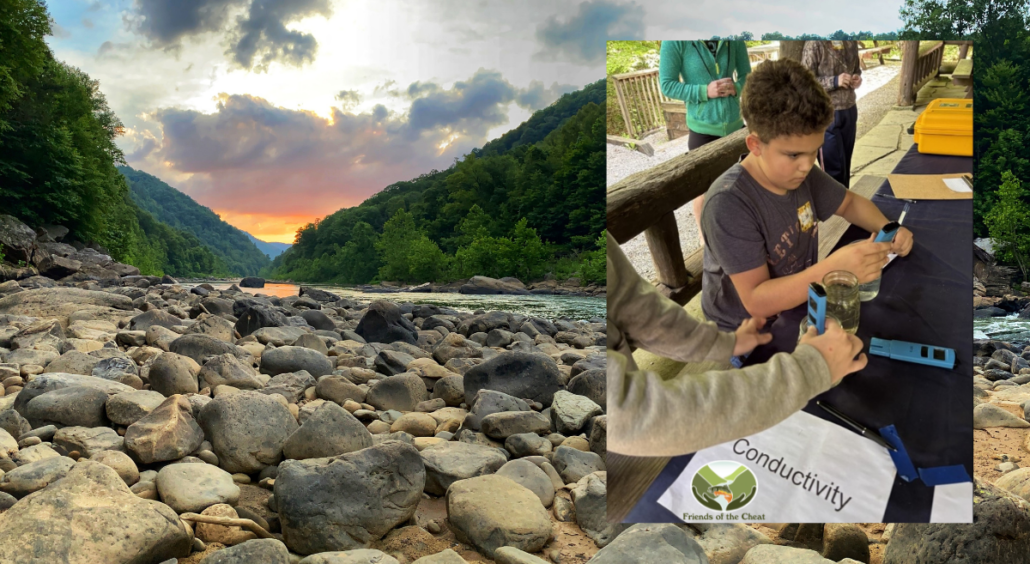
Scientists-in-training try their hand at conductivity sampling at a Friends of the Cheat education event.
WV Rivers staff joined Friends of the Cheat to help train the next generation of water quality scientists at an event this spring. The event was held along the Shavers Fork of the Cheat River, and although recent rains precluded river snorkeling, students were able to try their hand at water quality monitoring for conductivity, pH, turbidity and other parameters. Students also were able to see first-hand how the addition of limestone can reduce acidity to treat acid mine drainage.
Monitoring News: We’ve surpassed 10,000 surveys (!) and are adding new monitoring for data center impacts
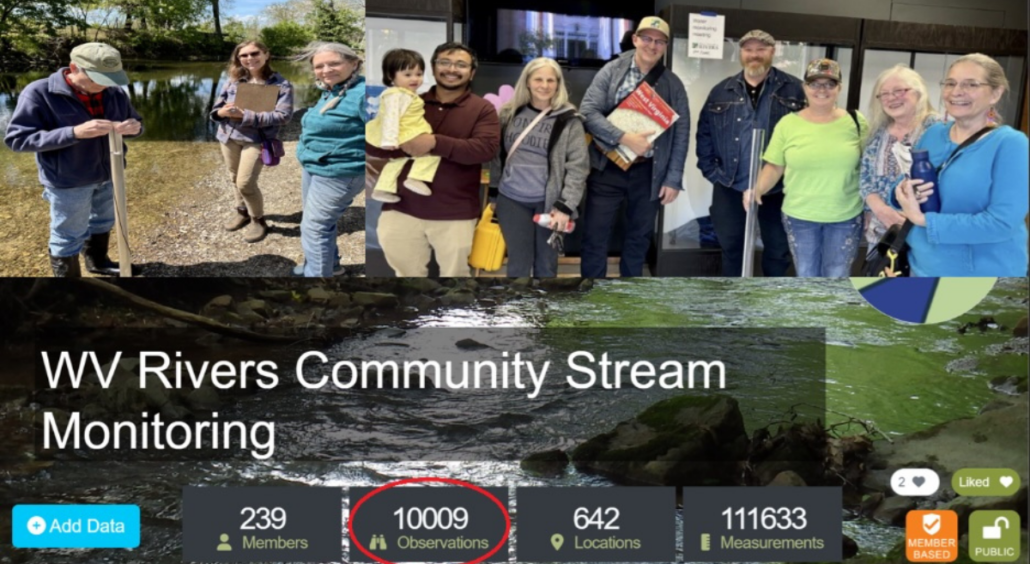
Water monitoring training with the Bedington team. Congratulations to all volunteers for surpassing 10,000 surveys!
Congratulations community scientists! Together, we have recently surpassed 10,000 surveys in the WV Rivers Community Stream Monitoring platform. This milestone reflects the importance of community science and is a testament to the hard work of many volunteers over many years! For instance, monitoring teams have conducted surveys to assess specific threats such as Corridor H, the Mountain Valley Pipeline, a proposed water bottling facility, and other issues, as well as to collect baseline data to understand climate change and land use impacts. Keep up the good work!
Also, new monitoring teams are coming together to assess potential impacts from data center development in WV. In Berkeley County, the Bedington team recently formed to monitor local streams that may be impacted by a hyper-scale data center planned for that area. In Tucker County, WV Rivers is working with partner organizations to set up water-level monitoring systems for municipal reservoirs that may be impacted by a data center complex proposed near Davis and Thomas. Our work continues to investigate the potential impacts of water extraction from mine pools in Tucker County. Please contact Than Hitt nhitt@wvrivers.org for more information.
Volunteer Spotlight: Will Shrader
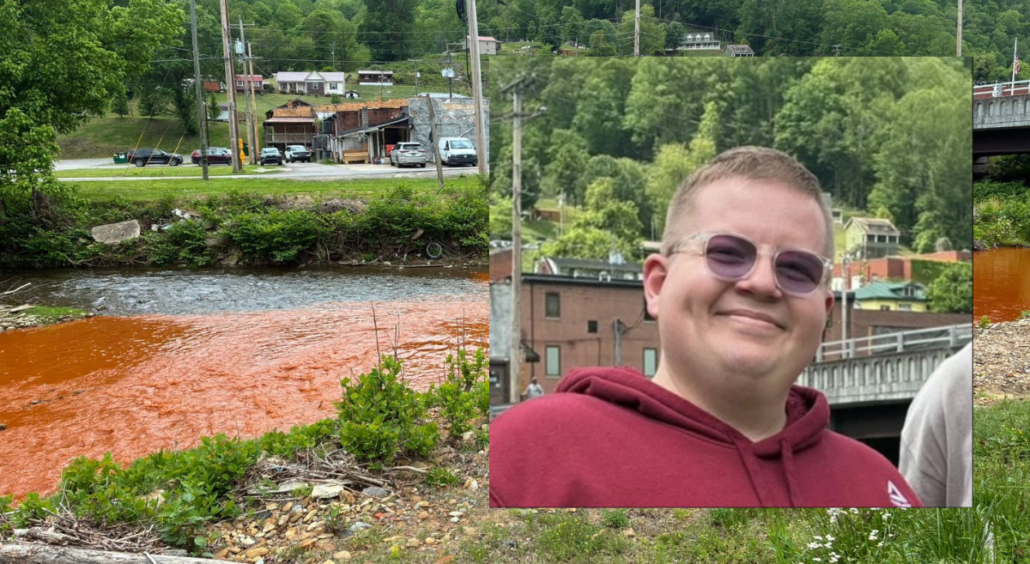
Will Shrader is a resident from Mingo County, West Virginia.
Local knowledge is absolutely vital to protect communities from bad water – and when Pigeon Creek in Mingo County suddenly turned orange, William “Will” Shrader didn’t hesitate. He got out there quickly to document stream conductivity and temperature with equipment provided by WV Rivers, and he used the WV Stream Watch App to report his observations. Not only did he document the source of the contamination, but he also showed evidence for significant downstream impacts into Pigeon Creek with several conductivity readings exceeding 1000 uS/cm (whereas a healthy stream in this region should be somewhere between 100-300 uS/cm).
You can see a map of his initial observations here. Keep up the good work, Will!
Technical Review: Lower Guyandotte TMDLs
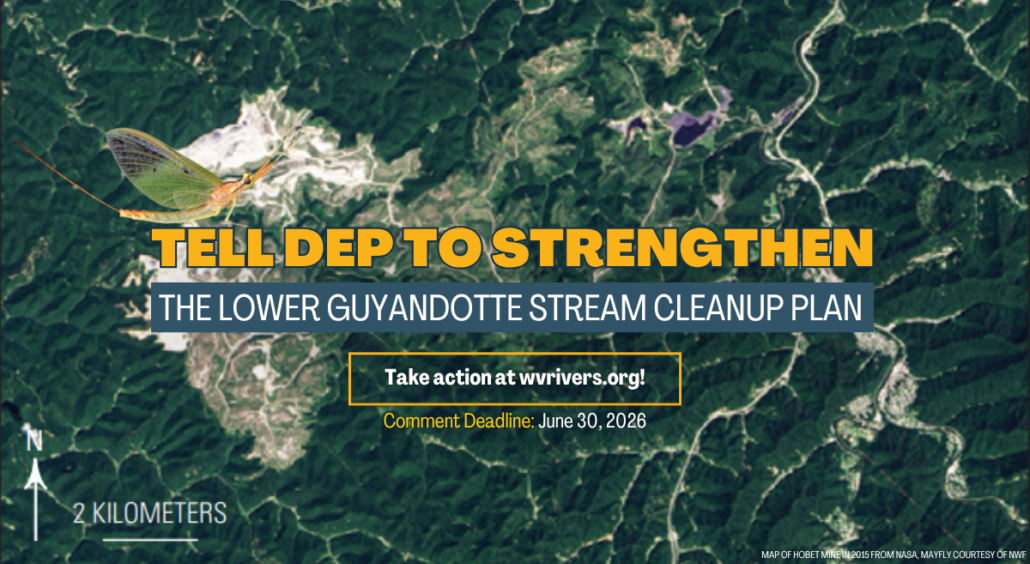
NASA satellite image of the Hobet 21 Coal Mine in the Lower Guyandotte River Basin, one of the largest mountaintop removal mining sites in West Virginia. Also pictured courtesy of National Wildlife Federation: a mayfly, an aquatic insect that can be harmed by ionic pollution from mining and serves as an indicator of stream health.
DEP recently published draft Total Maximum Daily Loads (TMDLs) for a set of streams in the lower Guyandotte River basin. The purpose is to protect aquatic life from ionic toxicity due to mining impacts. This work by DEP was compelled by litigation and a court-ordered consent decree.
WV Rivers is conducting a technical review and has identified the following significant concerns with the draft TMDL:
- The proposed Hazard Concentrations are not protective of aquatic life because DEP incorrectly filtered the benthic macroinvertebrate samples before analysis. Specifically, Hazard Concentrations (HC05) were calculated from Extirpation Concentrations (XC95) and species sensitivity distributions that artificially exclude sensitive species because many of the “reference” streams in this dataset exceeded 500 uS/cm and therefore were not true reference streams.
- The report is internally inconsistent because they state that individual ions are not suitable for this type of analysis, yet their analysis is based on individual ions. Moreover, using the sodium ion in particular is nonsensical because that ion is not highly toxic.
- The report excludes the best available science by ignoring established toxicity endpoints. In 2011, EPA established a conductivity threshold of 300 uS/cm to protect aquatic life in Appalachian streams including the Guyandotte River basin (USEPA 2011). However, DEP does not incorporate this research into their methods nor do they cite it in their literature review.
- The underlying biological model has not been approved by EPA. The report uses the Antigen Leukocyte Cellular Antibody Test (ALCAT) model, citing the draft 2024 303b-303d Integrated Report (IR) as justification. However, EPA has not approved the 2024 IR or the ALCAT model.
- The TMDL is based on flawed “reference” criteria that incorporate non-reference sites. As we noted in our prior comments to DEP on the 2024 IR, the proposed “Level-4 reference condition tier” allows for up to 22% of the watershed to include high-intensity urban development, agriculture, or “barren land” which often indicates past or present mining activity (IR page B-4) under the premise that because “approximately 78% of the state is covered by forest, a non-disturbed class” (IR page B-4) the inverse can be used to identify reference criteria. However, a statewide estimate of forest cover is not relevant for site-specific assessments of stream quality.
- The TMDL lacks enforcement for mining permits. On page 90, the draft TMDL report states that other planning processes “may identify alternate methods to attain compliance with the narrative criteria (i.e., TMDL endpoint) without ion reduction.” However, this negates the purpose of the TMDL to reduce ionic toxicity.
The public comment period ends June 30, 2026 and comments may be emailed to DEP at depWQSAS@wv.gov. Please contact Than Hitt nhitt@wvrivers.org for more information.