Update on Selenium Protections and What You Can Do Today
New Update as of 2/5/2026 @ 2:30 PM:
This bill has been passed out of the WV State Senate and is now headed to the WV House of Delegates. Note: the bill number has changed to SB 256. Our action alert has been updated.
Update as of 2/5/2026 @ 12:00 PM:
Last week, we published this action alert urging you to contact leaders in the Senate Judiciary Committee about Senate Bill 264. This is the bill to approve the WV Department of Environmental Protection’s (DEP) proposed changes that would weaken protections against selenium pollution.
More than 250 people took action, but still this bill passed out of committee and is now on the Senate floor for consideration. If it moves out of the Senate without an amendment, it then goes to the House.
Please take a moment to reach our directly to your two State Senators and your one Delegate using this link: act.wvrivers.org/a/2026-selenium-wqs
Originally posted 1/28/26:
West Virginia lawmakers will soon decide whether to approve the WV Department of Environmental Protection’s (DEP) proposed changes that would weaken protections against selenium pollution.
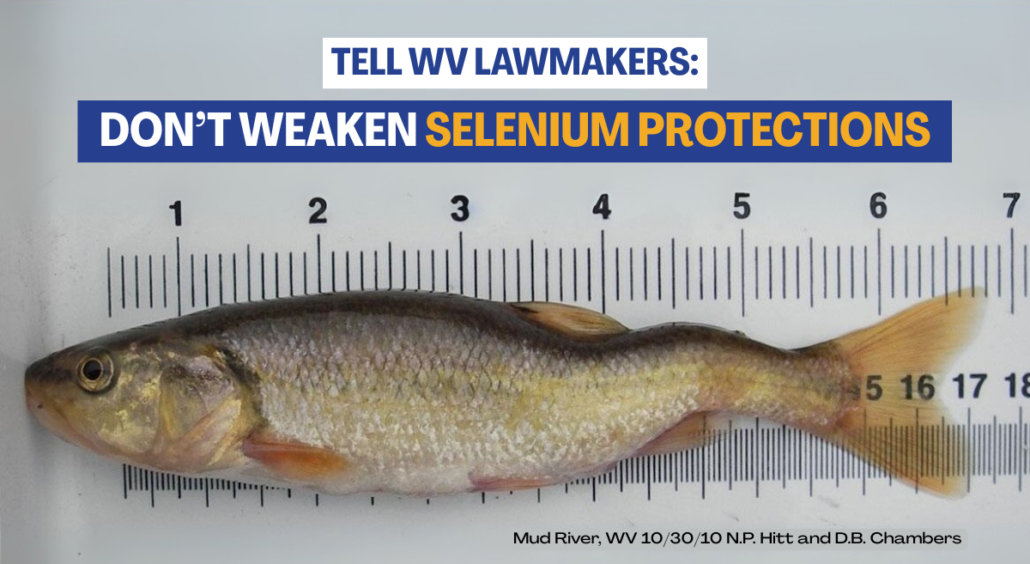
This is an image of a Creek Chub with selenium poisoning resulting in a crooked spine. The fish was collected from the Mud River by our Senior Scientist Than Hitt and his colleague during his time at USGS in 2010.
Selenium is a naturally occurring element that, at high levels, causes birth defects and developmental problems in fish and wildlife. In West Virginia, selenium pollution is often caused by mining activities that wash it into streams and rivers.
West Virginia currently regulates selenium levels both in fish tissue and in the water itself, but DEP is proposing to increase the allowable amount of selenium in fish tissue.
The agency claims this proposal is based on EPA science, but DEP has no plans to adopt EPA’s recommended limit for selenium in streams (3.1 µg/l).
This is a problem for two reasons:
- DEP is selectively using EPA science to weaken the fish tissue standard while ignoring EPA’s recommendation for a more protective water limit.
- The proposal lacks technical merit because it relies in part on stocked fish species (rainbow trout), which are not relevant for understanding how selenium causes reproductive failure in fish.
If lawmakers allow DEP to weaken the Selenium standard for fish tissue based on EPA’s science, they must also require DEP to implement a more protective water standard which uses that same science. Here is what we’re asking:
- Reject DEP’s proposal to weaken the selenium standard for fish tissue, and/or
- Support an amendment to adopt EPA’s recommended limit for selenium in the water column
Take action now: Urge lawmakers to support EPA’s recommended water limit for selenium.
Science-based standards matter for protecting West Virginia’s streams, rivers, fish, and wildlife. Thank you for advocating with us.
For clean water & healthy communities,
WV Rivers Coalition